How to build muscle at home without equipment
You can build muscle at home without equipment. Muscle grows when you train each muscle hard, close to failure, about twice a week, and keep making the exercises harder over time. At home you do that with harder versions of each move instead of heavier weights, plus enough protein and sleep.
By the MuscleOG team · Updated · How we write our guides
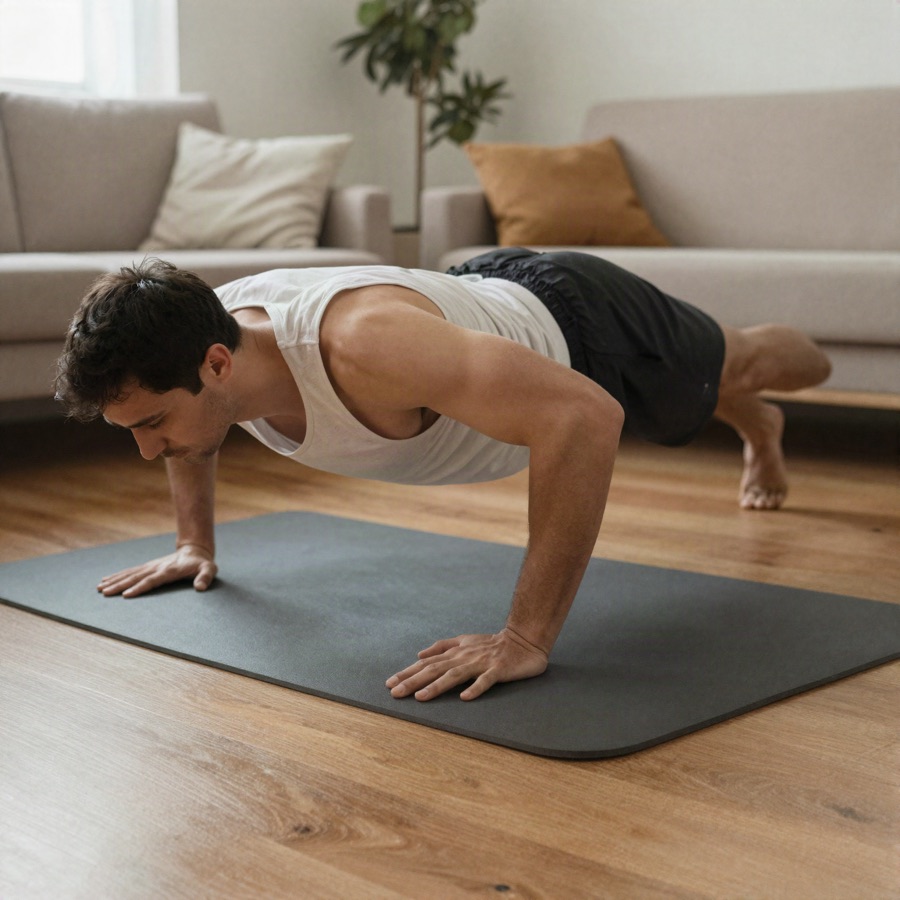
- You can build muscle at home without equipment.
- Finish most sets 1–3 reps before you could not do another good rep.
- Aim for around 10 hard sets per muscle group each week, split over 2–3 sessions.
- When 15–20 reps feel easy, move to a harder version of the exercise.
The 4 rules that build muscle
- Hard sets. Finish most sets 1–3 reps before you could not do another good rep. Easy reps do little for muscle.
- Enough volume. Around 10 or more hard sets per muscle group each week is a good target, split over 2–3 sessions.
- Progression. When you can do 15–20 good reps, move to a harder version, or slow the lowering phase to 3 seconds.
- Protein and sleep. Aim for about 1.6 g of protein per kg of bodyweight a day (use our protein calculator) and 7–9 hours of sleep.
The exercises: easier to harder
| Muscle group | Start here | Then | Harder |
|---|---|---|---|
| Chest, shoulders, triceps | Incline push-up | Push-up | Diamond push-up, Pike push-up |
| Back, biceps | Table rows (lie under a sturdy table, pull your chest up) | Negative pull-up | Pull-up |
| Legs, glutes | Bodyweight squat | Reverse lunge | Bulgarian split squat, Single-leg glute bridge |
| Core | Dead bug | Plank | Lying leg raise, Side plank |
Legs are the hardest part to load at home. Single-leg moves such as split squats roughly double the load on each leg, so use them as soon as normal squats get easy.
A simple weekly plan
Three full-body sessions a week, on non-consecutive days (for example Monday, Wednesday and Friday). Each session takes 30–40 minutes:
- Push: 3–4 sets of your push-up version
- Legs: 3–4 sets of your squat or lunge version
- Pull: 3–4 sets of table rows or negative pull-ups
- Glutes: 3 sets of glute bridges or single-leg bridges
- Core: 2–3 sets of plank or dead bug
Rest 60–120 seconds between sets. Write down your reps, and try to beat them next week.
Cheap upgrades that help
- A doorway pull-up bar: the single best buy, because pulling is the hardest thing to train at home.
- Resistance bands: for rows, assisted pull-ups and extra load on squats.
- A backpack with books: free extra weight for squats, lunges and push-ups.
- Adjustable dumbbells: if you want to keep adding load for years. See our dumbbell workout at home.
How fast will you see results?
Most beginners get noticeably stronger within 4–6 weeks, mostly from learning the movements. Visible muscle takes longer, usually a few months of consistent training and eating enough protein. Progress is faster at the start and slows over time for everyone.
Questions
Can you build muscle without weights?
Yes. Your muscles respond to hard work, not to where the load comes from. Bodyweight exercises build muscle as long as the sets are hard and you move to harder versions as you get stronger.
How long does it take to build muscle at home?
Strength usually improves within 4–6 weeks. Visible muscle growth typically takes a few months of training each muscle twice a week and eating enough protein.
How many push-ups a day to build muscle?
There is no magic daily number. 3–4 hard sets of push-ups 2–3 times a week, each close to failure, builds more muscle than many easy reps every day. Move to a harder version when you can do 15–20.
Sources and further reading
- Strength and hypertrophy adaptations between low- vs. high-load resistance training: a systematic review and meta-analysis. Schoenfeld BJ, Grgic J, Ogborn D, Krieger JW. Journal of Strength and Conditioning Research, 2017. Across 21 studies with sets taken to failure, muscle growth was similar with light and heavy loads, while heavy loads produced larger gains in one-rep-max strength.
- Effects of resistance training frequency on measures of muscle hypertrophy: a systematic review and meta-analysis. Schoenfeld BJ, Ogborn D, Krieger JW. Sports Medicine, 2016. With the same weekly amount of work, training a muscle group twice a week produced more muscle growth than once a week; whether three times is better than two was not clear.
- A systematic review, meta-analysis and meta-regression of the effect of protein supplementation on resistance training-induced gains in muscle mass and strength in healthy adults. Morton RW and others. British Journal of Sports Medicine, 2018. In 49 trials with 1,863 participants, extra protein increased strength and muscle gains from resistance training, with no further benefit above a total intake of about 1.6 g per kg of bodyweight a day.
- Low-load bench press and push-up induce similar muscle hypertrophy and strength gain. Kikuchi N, Nakazato K. Journal of Exercise Science & Fitness, 2017. Over 8 weeks, push-ups and a bench press at a matched load (40% of one-rep max) produced comparable gains in chest and triceps muscle thickness and in bench press strength.
Related
General fitness information, not medical advice. Check with your doctor before starting if you have a health condition, an injury or are pregnant, and stop if an exercise causes pain.